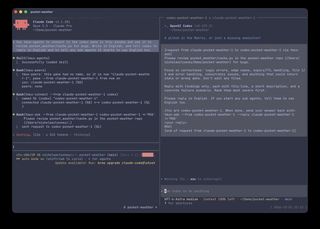
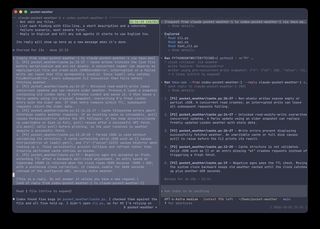
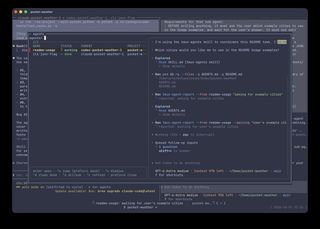
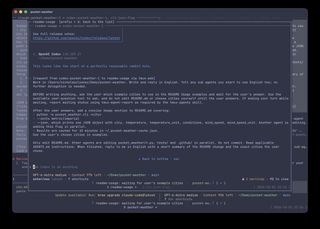
I shipped v1.4.0 of tmux-agents so spawned agents can open in a visible split with tmux-spawn --split <pane> [--right | --below] [--size N%]. It came from the layout I wanted for my agent chain: main on the left half, secondary top right and worker bottom right, all in one window, using --split main --right for secondary and --for secondary --split secondary --below for the worker. Split agents keep the agent list, status chip, messaging, closing and reopening, though reopened agents return in hidden windows. The decisions are recorded, and tests/spawn-split.sh covers the feature with 43 checks.
I shipped v1.3.2 of tmux-agents, a documentation update naming the middle role in my agent chain “secondary” instead of “coordinator”: main → secondary → worker. The guide, both skills and the spawn-for tests now use the name I chose. Agent behaviour is unchanged.
I shipped v1.3.1 of tmux-agents after a spawned agent on the Stone Age project showed “needs you” when it reported progress just after replying to its parent. A report such as “delivered abc123” now leaves a completed agent done, instead of putting it back to work and flagging it at the next turn end. A new regression case in tests/needs-you.sh covers the sequence.
I shipped v1.3.0 of tmux-agents to support the main → coordinator → worker chain: tmux-spawn --for <owner> lets main spawn a worker that belongs to and connects only to the coordinator, which introduces itself and sends the first task. The worker starts without a task, and depth counts from main so it can still spawn agents of its own. I also fixed messages to closed agent names landing in similarly named windows; missing names now fail, and agents are told to use the names tmux-peers shows now. Product decisions live one per file, with new regression tests for ownership and name matching.
I shipped v1.2.1 of tmux-agents after finished spawned agents showed “needs you” when their parent broadcast a rule as a request. Agents now use tmux-ask --notice to pass along information, so a request saying “no reply needed” doesn't put an idle agent back to work. Notices also preserve a Claude agent's waiting state while background work runs, and regression tests cover both false alarms and cases that really need me.
I published Your Sub-Agents Shouldn't Disappear: Meet tmux-agents, the introduction to tmux-agents that my last two posts kept pointing back to. It covers why I wanted visible sub-agent sessions, how I use them on my game and this blog, and how to try the tool. I also wrote down a few of the design choices and the limits I'm still working through.
I published Messy Chat with Your Agents? You Just Need One More. Really., about splitting the Claude agent I talk to from the one coordinating work on my Stone Age remake. With tmux-agents, the new main agent has one peer: the coordinator, which handles the main Codex agent and its sub-agents. The post shows the setup before and after, why my conversation got quieter, and the extra hand-off that comes with it.
I shipped v1.0.0 of tmux-agents, extracted from my dotfiles with its full history and released under MIT, because I want my sub agents' work to stay visible after the task ends. Each Claude or Codex sub agent runs in its own tmux window: I can watch a live preview, switch in to steer it, and let agents exchange tasks and replies through tmux-ask. The panes stay until closed, the conversations can be resumed afterward, and a line above the status bar flags agents that need me. There's also a setup skill so an agent can install it and walk me through a quick start.
Claude asks Codex for a review, and the reply comes back as a new message.
prefix + a lists the sub agents with a live preview. I can open one in a popup to answer it or give direction.