Cut v1.0.0 of little-snitch-review-kit, a personal workflow I use for reviewing Little Snitch exports with an AI assistant.
The Little Snitch UI is great at intercepting one connection at a time, but it does not answer the longer questions I actually care about: what is this process talking to over a week, and which observed traffic has no explicit rule covering it.
This release bundles the analysis scripts (per-app rollups, uncovered pairs, denied traffic), the importable .lsrules builders (HaGeZi Pro and reviewed consolidation plans), and the docs and tests around the human-in-the-loop review workflow. The core constraint stays: scripts surface candidates, humans make the trust decisions.
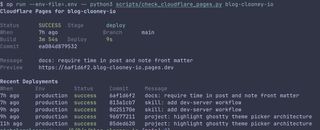
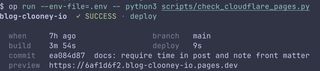
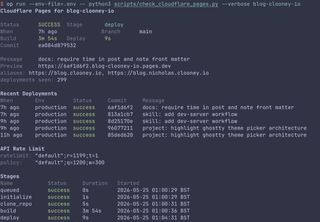
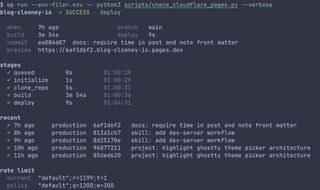
I've been iterating on scripts/check_cloudflare_pages.py, and this one ended up being a pretty clean example of where Claude currently feels stronger than Codex for TUI / UI design.
Codex got the script started and helped shape the core deployment-status workflow, but when it came to making the terminal output feel actually polished, especially across both the short and verbose views, Claude was noticeably better. At its best Codex still seems to struggle a bit with this kind of presentation work, so I ended up handing the UI pass over to Claude even though Codex had started the script.
View
Codex
Claude
Short version
Verbose version
Short and verbose output passes for the same Cloudflare Pages deployment-status script, comparing Codex against Claude.
I tagged a ProjectSpire snapshot for 2026-05-11, but this one feels different because I barely did any of the implementation myself.
My Codex usage is nearly gone, so Claude carried most of the work while I was busy elsewhere: parsers for relics, potions, events, and monsters; shared parser utilities; tests; and a few devlogs.
I haven't built the UIs I need to verify Claude's parser work against the actual game properly. So I don't have that confidence in its work yet without the validation.
I miss Codex and the clearer feedback loop, the back and forth, and...
Most importantly my own deeper understanding of how everything ties together.
After a few weeks working on ProjectSpire with Codex, I’m leaning toward it as my default for software engineering projects. The main frustration has been hitting the Pro account limit; otherwise the quality has been good, the interaction feels responsive, and the output gives me instant feedback while it works. Claude Code still feels more like a black box to me: it can disappear into minutes of research and thinking on its own, and the effective limit feels lower. That tradeoff matters, because for this kind of project I want a tight engineering loop more than a long silent reasoning pass.
Shipped Card Parser v0.2.3 to ProjectSpire, which adds calculated variable resolution, numeric symbol extraction, and conditional text formatters. Cards like Ashen Strike now show computed damage values instead of raw placeholders, and I've added choose, cond, inverseDiff, and boolean formatters for rendering conditional card text. The parser now threads card type, target type, and runtime display vars (HasRider, Sapping, Energized, etc.) through text resolution, making the pipeline much more precise about card state and context.
The whole card parser has been built in this mode: I act as architect, GPT-5.5 acts as developer. Every meaningful parser improvement came from me inspecting concrete generated JSON against real card examples and asking source-fidelity questions. GPT-5.5 didn't discover that cost upgrades can be negative, or that Bash's upgraded Vulnerable value wasn't being applied, or that X-cost cards needed their own shape. I did, by reading the output and comparing it to what the game actually does.
The pattern that emerged: I'd spot a class of issue on a specific card, explain what the game source was doing and why the output was wrong, and GPT-5.5 would produce a working fix. Then I'd push to turn each discovery into a repeatable check rather than a one-off patch. The coverage audit script, the unresolved placeholder CSV, the hard failures on missing source files: all of those came from me steering toward systemic fixes after catching individual bugs.
What GPT-5.5 is good at in this loop is the mechanical throughput. Regex extraction, threading new state through a resolution pipeline, mirroring changes to the audit script, regenerating 55 JSON files, splitting work into clean commits. The domain knowledge, the quality bar, and the architectural decisions all come from the human side. GPT-5.5 doesn't know what CalculatedVar means in the game engine or why display vars like HasRider matter for conditional text. It doesn't need to, once I describe the shape of the problem clearly enough.
The productivity gain isn't just speed. It's that I can stay at the architectural level, thinking about which cards are still wrong and why, without losing momentum to implementation mechanics. The feedback loop stays tight: inspect, identify, describe, implement, verify, repeat.
Here's what a fully resolved card looks like now. Ball Lightning's resolved block shows the base and upgraded display states, with structured text runs that carry source variable references and style annotations:
I’ve been working since last night and today with agents to document how Slay the Spire 2 works, prototype a Spire API and a REST API on top of it, and shape a WIP card parser that turns C# into JSON structures. That work is captured in ProjectSpire snapshot/2026-04-19, which gives me a concrete snapshot of the game model and tooling so far.
I’ve set up ProjectSpire Lab so I can run a script that pulls a decompiled copy of Slay the Spire 2 for local experimentation; the game code itself stays out of Git because I do not have a license to commit it. The setup lives in NicholasClooney/ProjectSpire. It gives me a clean foundation to build mod tooling from.
This grows out of Cloudflare Build Notifications via Email Routing and Email Worker, but I’m now moving the Email Worker out of the Cloudflare dashboard editor and into Git in NicholasClooney/cloudflare-email-to-webhook-worker. The goal is to keep the worker version controlled, review changes before deploys, test locally, and configure it with Wrangler instead of only editing it in the Cloudflare web UI. Right now it is still mostly Wrangler init plus the example email worker, but that is a solid foundation to build from.
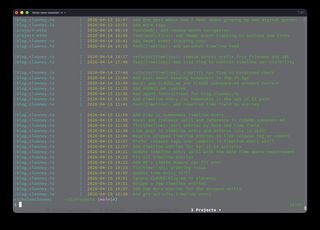
I created git-activity in a631c98 so I can quickly answer "what have I been working on?" It walks a directory tree, finds the Git repos underneath it, and shows the latest log entries from each one in a single pass. It also supports a few filters, which is handy when I only want to review a slice of recent work; for example, from my projects folder I can run:
git-activity -r blog -m feat -x chore
That recursively scans repos, focuses on feature work, and leaves chores out of the list.