Nicholas Clooney

Timeline

#ai-assisted

11 entries following this thread through the timeline.

Nicholas Clooney

thoughts: Multi-project agent orchestration

A new style of working with AI has been clicking for me lately: keeping several projects open at once, letting the main agent spawn off sub-agents per project, then hopping between them as work lands.

The glue is AGENTS.md and CLAUDE.md in each repo, which keeps every spawned agent oriented to that project's conventions while I focus on the next handoff. The loop in each project stays the same: pick a feature, write tests, document progress and findings as it goes, commit atomically.

It is genuinely engaging, more like conducting than coding, but it burns through tokens fast, especially on top-tier models like Opus 4.7 or GPT 5.5.

A few cost-saving strategies I've landed on: drop to lower-tier models where the work allows; instead of paying for the $100 tier at a single provider, take the $20 tier at both OpenAI and Anthropic and run them side by side; and lean into the fact that each model has its own strengths and weaknesses, just like any tool. It's the vim vs emacs thing again. There is no single best editor, only what suits the job in that moment (I use both, with evil-mode in Emacs as the vim layer).
Nicholas Clooney

feature: Little Snitch Review Kit v1.0.0

Cut v1.0.0 of little-snitch-review-kit, a personal workflow I use for reviewing Little Snitch exports with an AI assistant.

The Little Snitch UI is great at intercepting one connection at a time, but it does not answer the longer questions I actually care about: what is this process talking to over a week, and which observed traffic has no explicit rule covering it.

This release bundles the analysis scripts (per-app rollups, uncovered pairs, denied traffic), the importable .lsrules builders (HaGeZi Pro and reviewed consolidation plans), and the docs and tests around the human-in-the-loop review workflow. The core constraint stays: scripts surface candidates, humans make the trust decisions.

Nicholas Clooney

thoughts: Codex vs Claude on Cloudflare Pages TUI polish

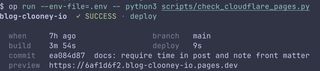
I've been iterating on scripts/check_cloudflare_pages.py, and this one ended up being a pretty clean example of where Claude currently feels stronger than Codex for TUI / UI design.

Codex got the script started and helped shape the core deployment-status workflow, but when it came to making the terminal output feel actually polished, especially across both the short and verbose views, Claude was noticeably better. At its best Codex still seems to struggle a bit with this kind of presentation work, so I ended up handing the UI pass over to Claude even though Codex had started the script.

View Codex Claude
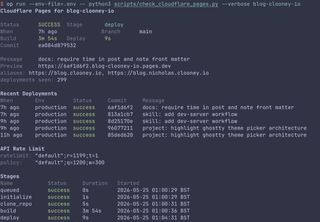
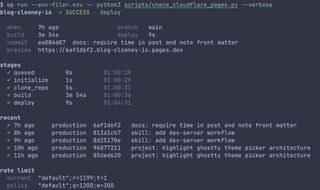
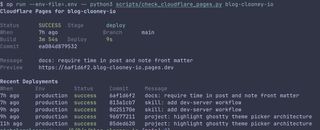
Short version Short terminal output version of the Cloudflare Pages deployment status script produced with Codex Short terminal output version of the Cloudflare Pages deployment status script produced with Claude
Verbose version Verbose terminal output version of the Cloudflare Pages deployment status script produced with Codex Verbose terminal output version of the Cloudflare Pages deployment status script produced with Claude
Short and verbose output passes for the same Cloudflare Pages deployment-status script, comparing Codex against Claude.
Nicholas Clooney

wip: ProjectSpire Claude snapshot

I tagged a ProjectSpire snapshot for 2026-05-11, but this one feels different because I barely did any of the implementation myself.

My Codex usage is nearly gone, so Claude carried most of the work while I was busy elsewhere: parsers for relics, potions, events, and monsters; shared parser utilities; tests; and a few devlogs.

I haven't built the UIs I need to verify Claude's parser work against the actual game properly. So I don't have that confidence in its work yet without the validation.

I miss Codex and the clearer feedback loop, the back and forth, and...

Most importantly my own deeper understanding of how everything ties together.

Tomorrow. Today has been a long day.

Nicholas Clooney

thoughts: Claude Code friction while Codex is capped

Almost running out of my weekly Codex / GPT token usage, so I switched to Claude for a few hours.

Somehow the experience feels much higher friction.

It likes to spend a long time thinking even for relatively simple tasks. For example: "write this devlog for me." It already had detailed guidance (ProjectSpire Devlogs CLAUDE.md) plus example documents in the same folder.

If it were GPT, it probably would have been done in seconds. Claude spent nearly a minute still "flabbergasting..." until I stopped it and asked what it was doing. Its response was essentially: "I was reading unnecessary documents."

Then there's the terminal behavior.

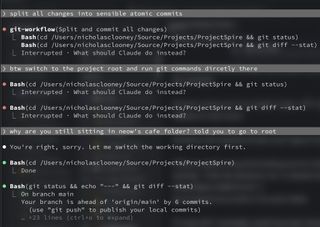
I wanted it to run some git commands, but it kept doing cd project-root && git ... everywhere. I genuinely do not understand why, because it can already execute commands from within the project context directly.

Claude Code repeatedly running git commands through cd into the ProjectSpire folder after being asked to switch to the project root once
Claude, Claude, Claude...

I explicitly told it: "cd into the project root once and then run git commands directly without repeating cd." Nope. It still kept issuing (cd ... && git ...) commands until I corrected it a second time.

I'm genuinely having a hard time getting used to working with Claude. Curious what other people's experiences have been.

Nicholas Clooney

blog: AgentOS: The Agent Environment That Gets Smarter As You Build

Published AgentOS: The Agent Environment That Gets Smarter As You Build, a post about the project environment I am building around AI agents so a fresh session does not have to rediscover the same context every time.

It uses ProjectSpire as the working example: instructions as project memory, plans for intent, Captain Logs for collaboration taste, devlogs for technical history, and skills or workflows for repeated mechanical steps.

The useful idea is that the repo should accumulate context as it is used, so the human still supplies the judgment, but the surrounding system gets better at carrying that judgment forward.

Nicholas Clooney

feature: ProjectSpire STS2 resource recovery workflow

I worked with GPT-5.5 on a reproducible Slay the Spire 2 resource extraction plan and then landed it in ProjectSpire across the recovery scripts, allowlist, generated resource subset, image-format experiment, and workflow docs.

The Principles matter more than the files: keep the full recovered dump local and ignored, track only curated resources with a current use, make extraction scriptable instead of manual, prefer readable Python tooling, keep binary assets repo-friendly with WebP and Git LFS, and write down the decisions close to the evidence.

The implementation follows that shape by keeping Lab/unpacked/ as the local source dump and generating Lab/resources/ from Lab/resources.allowlist.yaml, starting with localization plus WebP q85 card portraits.

That gives my STS2 projects inside the ProjectSpire monorepo access to assets like this at roughly a fraction of the original size, around 10%, without needing to commit the full recovered dump.

Recovered Slay the Spire 2 card portrait for Believe In You
One of the recovered card portraits from the first curated resource subset.

You can find the commits/changes here: https://github.com/NicholasClooney/ProjectSpire/compare/a1fd19e...a1b6e9d

Nicholas Clooney

blog: The Brain That Grew — Then Shrunk: What I Just Discovered

I published The Brain That Grew — Then Shrunk: What I Just Discovered, a long-form note that starts from a Cleo Abram YouTube Short and then follows the research on human brain evolution, the unexpected Holocene shrinkage, and the idea that culture may have taken over part of the cognitive load. It is the kind of rabbit hole post I like writing here: one short video, a lot of reading, and a sharper takeaway than I expected.

Nicholas Clooney

note: Localization Formatters - Slay The Spire 2 Research Note

I published Localization Formatters - Slay The Spire 2 Research Note, a ProjectSpire note on how card localization formatter functions such as diff() are resolved and applied. GPT-5.5 researched and wrote the note, and I am honestly amazed by how well and how quickly it produced a detailed explanation from decompiled sources in minutes. This is exactly the kind of agent-assisted research loop that makes ProjectSpire feel much more possible.