I released v1.15.0 of my skills. engineering-standards now asks for explicit argument labels and gains semantic code layout conventions, covering declaration ordering, enum projections and multiline Swift layout, in a new references/layout.md. wrap-up can now resume from HANDOFF.md after a clear, so the next session picks up the parked context instead of me pasting it back in. The Swift examples in behavior-tests are now generic rather than tied to one app.
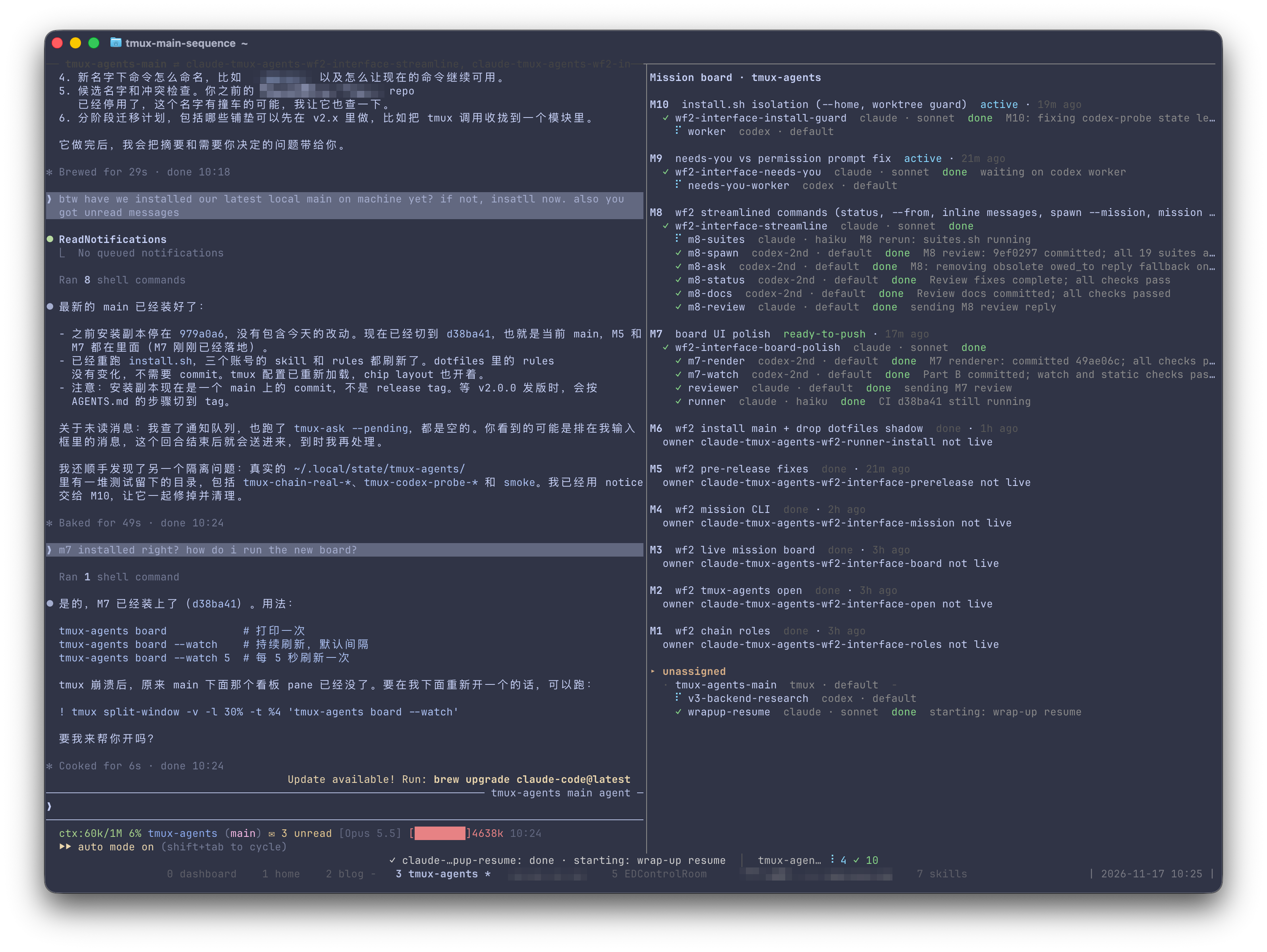
The main agent on the left, tmux-agents board --watch on the right. Click for the full size.
I'm rebuilding how my tmux-agents team works. The old main → secondary → worker chain burned most of its tokens on a secondary that never cleared its context and got the most messages: on the tmux-agents project alone, the secondary used 143M tokens to the main's 91M. Now there is one Opus main that only talks to me and decides, a short-lived Sonnet interface per mission that hands out the work, reviews it and lands it, then closes, plus Codex workers, Opus reviewers and Haiku runners for tests and CI.
Each mission is a record managed with tmux-agents mission, shared across worktrees, and tmux-agents board --watch is a live, read-only pane that groups every agent under its mission with its model, state and progress. One glance and I can see the whole team.
It's part of a bigger push to trim the fat. A fresh Claude session used to spend about 50k tokens before I typed anything; after measuring and cutting unused tools, MCP servers and hidden skills, it starts at about 16k. And I wrap up, then clear far more often, so no agent drags 150k of scrollback through every request.
All of it is coming soon: role-based spawning, mission records, the board and a single tmux-agents status command will ship together as tmux-agents v2.0.0, with posts on the new team flow and on where my Claude tokens actually went.
I released v1.12.0 of my skills. The error-boundary rule in engineering-standards now says that when a boundary normalises a failure, it keeps the diagnostics that failure needs, in logs or error metadata as the boundary chooses. Intentional cancellation counts as lifecycle control, not a request failure the user has to handle. Typed errors owned by each layer stay as they were, and the rule still doesn't prescribe how to surface underlying errors, a universal cancelled case or a logging implementation.
I shipped v1.24.1 of tmux-agents to correct the digest's reading command to tmux-notes --all --keep-unread and tighten up recovery after clearing an agent's context. A short resume phrase restores the existing chain role, using a temporary, never-committed HANDOFF.md to choose what to continue. The main agent also checks and updates the new session's resume ID in main-sequence, waiting for Codex to finish its first turn before recording it. All 68 offline test suites, seven PR CI checks and the required probes on two Codex accounts passed; I've updated the local installation and status chip.
I released v1.11.0 of my skills. engineering-standards now has rules for what crosses a boundary: no enum that only mirrors domain cases to serialize them, a wire-format value only when it is a deliberate choice, named payloads when several values travel together, members grouped by responsibility in Swift's order, and a test rule to assert the final wire output. wrap-up now offers numbered choices for what to keep before a session clear, and parks the picked context in a local, uncommitted HANDOFF.md so the next session picks up where this one stopped.
I shipped v1.24.0 of tmux-agents, which adds quiet notes for the chatter between agents that doesn't need to interrupt anyone. tmux-ask --note leaves a note instead of pasting a prompt, and tmux-notes reads them with one read cursor per receiver; Claude gets an unread summary through its prompt hook and Codex checks at turn start. After five minutes idle (configurable), an agent gets a digest that continues from the last update until I speak, bare tmux-notes --count feeds status lines, and the "stopped without replying" reminder now arrives as a quiet note. The agent-chain rules also spell out what stays a reply, a request or a notice.
I released v1.9.0 of my skills. Every item in a design-lab gallery now has a short, stable ID in a chip with a Copy ID button, and each round's landing page lists every item with its ID. When the phone blocks the clipboard, the chip's text is selected and the page says "Selected, copy it". It came out of reviewing social preview cards from my phone, where pointing at "the third Glass card, the dark one" got old fast; now I paste C3-glass-series-dark back and the agents know exactly which one I mean.
I shipped v1.23.4 of tmux-agents, a patch release that makes clearing a session by hand a supported path. After /new in Codex, the next turn end with a verified agent ID rebinds the pane and its record to the new thread, so tracking and tmux-spawn --resume follow the latest conversation instead of staying stuck on working. Parents no longer get a "stopped without replying" reminder while a child is still working, and a new prompt or delivery clears the old activity label. In tmux-peers and tmux-connect --list, the COMMAND column now shows the agent kind (claude, codex or a Codex profile) and marks it (exited) when it has quit, instead of showing the shell that started it.
I wrote The Blog Themes I Would Never Have Built, and the Freedom to Be Picky about exploring eleven theme options while working on three to five other projects over a day of on-and-off work. It follows the design lab, the ideas I kept or dropped, and the theme switcher I kept refining with the agents. AI made trying cheap enough to take more possibilities seriously, but getting the design right still needed human judgement.
I shipped v1.23.3 of tmux-agents to fix spawned Codex agents appearing to be working while stuck at a folder trust prompt. Agents launched through tmux-spawn, including Codex profiles, now show permission, pause their work timer and tell their parent that the task has not started yet. The user still decides whether to trust the folder; nothing confirms it automatically. All 64 offline test suites, seven cross-platform CI checks and release probes on two accounts passed.
I shipped v1.23.2 of tmux-agents, a patch release that removes tmux-clear-context and the chain-reset skill from v1.23.0 and v1.23.1. Instead, I clear agents by hand and tell the main agent it is the main of an existing chain. The agent-chain skill now explains how a restarted main, secondary or worker finds its members with tmux-peers and re-briefs them instead of starting a new chain. install.sh removes the stale links. The fix that records Claude's new session ID stays.
I shipped v1.23.1 of tmux-agents, a patch release for tmux-clear-context. It now treats the dim suggestions and placeholders in Claude and Codex prompts, such as gray history ghost text or "Ask Codex to do anything", as an empty prompt, so idle agents can be cleared. If it refuses after typing the command, it erases the command again when that is safe; otherwise the error says the input was left as is. Refusals for a working agent now show how old the recorded state is.
I shipped v1.23.0 of tmux-agents, a minor release with a new command and skill. tmux-clear-context --from ME PEER clears a stopped Claude or Codex sub agent in place, sending /clear or /new while keeping its pane, name and connections. It refuses when the agent is working, in copy mode, mid-typing, has queued messages or has text in its prompt. Claude now records its new session ID at each turn start, so resume follows an agent across a /clear. The new chain-reset skill builds on it: after I clear the main agent, /chain-reset collects unfinished work, then clears and re-briefs the secondary and worker.
I released v1.8.0 of my skills. It ships two new skills: engineering-standards, the foundation I want every app to start from, and catch-up, which answers "catch me up" with only what changed since my last message. afk now briefs me on return in the same catch-up shape, and agent-docs keeps each SKILL.md to the minimal core, with everything else in linked reference files.
I added catch-up to my skills in b40a054. I come back from a break or a flood of agent notices and ask "catch me up" or "cmu". I want only what changed since my last message, concise and in a fixed shape: what landed, what is pending or blocked, and a decision only if one is needed. Long recaps bury the decision and repeat messages I can already read, so the skill also rules out preamble, tool narration and restating what's already on screen.
description: Brief the user on what changed since their last message, in a fixed shape. Use when the user says "catch me up", "cmu", "since my last message", "what happened", 发生了什么 or 进展.
---
# Catch up
Cover only what happened after the user's last message. Use these parts in order, omitting any part with no content:
1.**Landed:** what landed and the state now.
2.**Pending:** what is pending or blocked.
3.**Decision:** a decision the user must make, as one question with options.
Use one or two sentences per part. Concise means shape and density. Do not restate messages the user can read directly, such as a secondary's replies in a chain; do not narrate tool calls. No preamble or closing.
"What are you doing / why is it slow" is not a catch-up: answer that first in one or two sentences, then continue the work.
I added engineering-standards to my skills in 8329df9. I want every app I build to start from the same foundation: simple objects, strong single responsibility, strong boundaries, full dependency injection, and state and logic you can test. Writing it down once means agents build to that standard by default, instead of me re-explaining it on every project.
Five core rules up front.SKILL.md holds them, each a principle with its Swift form; 17 more rules sit in three reference files (structure and dependencies, screen state and presentation, tests) loaded only when needed.
Fake the world, keep my layers real. Tests replace only the outside world; canned values at a unit's own injected functions are fine, recording mocks are out.
Precise values stay precise. Money and similar values use a decimal type parsed from strings.
description: Build and review app code to a fixed set of engineering standards (simple objects, single responsibility, strong boundaries, full dependency injection, testable state and logic), each stated as a principle with its Swift or SwiftUI form. Use when designing or reviewing app architecture, wiring dependency injection, writing view models or view states, mapping network responses and errors into domain types, applying code layout conventions, or when the user says "our standards" or "to our engineering standards".
---
# Engineering standards
Principle first, then the Swift form as one example; in another language, use its plainest idiom for the same rule. Test shape, doubles, factories and fixtures are in the `behavior-tests` skill; the rules in the tests reference add only what that skill leaves open.
## Core
1.**Simple objects.** Values and functions before classes and interfaces. Domain and view-state types are immutable values; computation is pure functions grouped by topic. A class only where mutable, observed state lives (the view model); an interface only for a real boundary, never one interface and one mock per dependency. Swift: `let`-only structs and enums, `static func`s on a `nonisolated enum`, one `@Observable` class per screen.
2.**Strong single responsibility.** One type, one job, named after the job. Networking alone is four types: configuration (base URL, version), endpoints (paths), client (fetch and decode), mapper (wire type to domain). The reverse holds too: actions that share one piece of state stay in one type instead of being split to shorten it.
3.**Strong boundaries.** Each layer speaks only its own types, and raw data stops at the edge. A weather DTO holds the server's strings; the repository maps it to a `Forecast` with typed temperatures; every failure becomes the layer's own error before it crosses. Callers consume capabilities (`fetchForecast`), never construct lower layers. A view sees view states, never a DTO or the client.
4.**Full dependency injection.** Every side effect (network, stored data, a delay's length) is passed in at construction with no default, so a caller can't forget it and a test can't be fooled by a built-in. One composition root: the entry point reads the configuration switches and builds the live wiring as locals in one function; preview or demo wiring is a second set that doesn't ship. Nothing below the root reads a global. Time and delays are injected only when a test needs to control them; a presentation delay doesn't earn a clock. Swift: `@Sendable` closures in `init`; `Dependencies+Live.swift`, and `Dependencies+Preview.swift` behind `#if DEBUG`; no `URLSession.shared` outside the root.
5.**Testable state and logic.** State is a value you can assert on: one state enum with payloads, readable by all and written only by its owner's actions. Logic is a pure function whose inputs (locale, units, the loaded data) are parameters, so a test needs no environment. Tests drive the real types through the user's flow and fake only the outermost boundary. Swift: `enum State: Equatable`, `private(set) var state`, `#expect(viewModel.state == .loaded(expected))`.
## Reference
- Read [structure.md](references/structure.md) when separating view models from view states, wiring dependencies, defining configuration, concurrency, validation and error boundaries, choosing request serialization or boundary payloads, naming functions and their argument labels, grouping members and function stages, or choosing enum projections versus behavioural pattern matching.
- Read [layout.md](references/layout.md) when formatting multiline conditions, arguments, parameters or nested calls.
- Read [screen-state.md](references/screen-state.md) when deriving screen state, formatting values, guarding async actions, extracting components or documenting escape hatches.
- Read [tests.md](references/tests.md) when choosing test boundaries, recording fixture provenance, covering screen states offline or verifying request wire output.
## Done
Each changed type has one job and a name that says it, every side effect enters through its initialiser, every new boundary has its own types and error, and each behaviour has a test that reads as the user's flow with only the world faked.
I released v1.4.1 of my skills. It ships design-lab, a private lab for comparing mockups and image rounds on one phone-friendly index before building anything. Its local server never serves hidden files or directory listings, with offline tests in the release checks, Tailscale is now optional, and dark screenshots set the colour scheme explicitly so they no longer depend on the Mac's own appearance.
I shipped v1.22.0 of tmux-agents, a minor release with new options. Rows in a tmux-agents main sequence now accept command=CMD: the window opens at the project directory, runs the command in the configured shell, and keeps an interactive shell afterwards even if the command fails. add, set and unset edit the field. I use it to start the Agent Fleet Command server alongside the other windows. The agent-chain skill also gains an optional Fleet Command section: when the fleet-command CLI is installed, chains follow the missions skill, with the main registering missions, the secondary reading the inbox and owning status, and the worker logging progress. Without it, chains behave exactly as before.
I added design-lab to my skills in 549cfa8. With how easy it is to try things with AI agents, I like to experiment with designs, and this skill captures the lab I ran while redesigning this blog's themes: every mockup round, image round and verdict on one private, phone-friendly index, before any real code.
Nothing reviewed gets overwritten. Each revision is a new folder next to the old one, so I compare against what I actually saw.
Verdicts are my words. Loved, Approved, Not picked and Dropped are only recorded when I say so, and each one lands in the gallery, the index and the plan at the same time.
Phone first and private. Every page is checked at phone width in light and dark, served from a no-store local server on 127.0.0.1, shared over my tailnet only when one is available.
A finalists view with a side-by-side compare mode helps pick a default once most verdicts are in.
description: Run a private design lab for a project, with throwaway mockups and image rounds on one phone-friendly index the user reviews on their phone or the same machine, ending in a decision recorded in the plan. Use when the user wants to explore visual directions, themes, mockups, covers or image options before building, asks for a lab, a gallery, a revision round or a finalists view, or says 设计实验室 / 出几版看看.
---
# Design lab
The lab answers "which direction?" before any real code. Its output is a decision written in the plan doc, never production code. Everything in it is throwaway.
## Rules
-**Private and uncommitted.** The lab lives in a gitignored, build-ignored drafts folder (e.g. `local-drafts/lab/`). Check both ignores before the first file. Nothing in it reaches git, a build, a push or a message to another project.
-**Serve only what is visual.** The served root holds the index plus symlinks to mockup and image folders; never drafts, notes, `.temp`, `.env` or secrets. Bind to 127.0.0.1 with caching off. If a tailnet is available, use `tailscale serve` for phone review; otherwise review on the same machine at 127.0.0.1. Never bind to 0.0.0.0 or substitute a public tunnel.
-**Never overwrite a reviewed version.** A revision is a new folder next to the old one (`x-r2`, `x-r3`, `paper-contrast-a/b/c`, `dark-aurora`, `dark-indigo`). The user compares against what they saw.
-**Phone first.** Check every page at 390px: one column, no horizontal scroll. Every mockup in light and dark unless it is declared single-scheme. Record body and label contrast ratios (aim for 7:1 body text) in each round's notes.
-**Verdicts are the user's words.** Badges: Loved, Approved, To review, To pick, Not picked, Dropped, On hold. Never mark anything approved, picked or dropped unless the user said so; quote them in the note. If a verdict is ambiguous ("aurora indigo": one palette or two?), confirm before recording it.
-**Image rounds.** Unless the user gives an art direction, let the model choose and vary styles. Save every prompt in `prompts.json`. No text, logos, trademarks or personal details in images. Note the target crop ratio (e.g. 100:56) and check each image in that crop. Record each rejected round with the user's reason ("too close to X's style") so the next round avoids it.
-**In an agent chain:** the main relays verdicts as notices and revision asks as requests; answer each revision round with one batched reply holding all links.
## Ops
1.**Start the lab.** Run [scripts/serve-lab.py](scripts/serve-lab.py) `<lab dir> [port]` in the background. With a tailnet, optionally run `tailscale serve --bg --https=<port> <port>` for phone review; otherwise use `http://127.0.0.1:<port>` on the same machine. Done: the tailnet URL loads the index on the phone, or the loopback URL loads it locally; in either case, a reload after an edit shows the edit.
2.**Create the index once.** Copy [references/lab-index-example.html](references/lab-index-example.html) to `<lab dir>/index.html` and replace its sample rows. One row per experiment of any kind (mockups, image rounds, covers): title, date, status, note with verdicts, thumbnail. Done: every experiment the user has seen is a row.
3.**Add an experiment or round.** Build it in its own folder, symlink it into the lab root, add or update its row. Done: the row links to it, its thumbnail loads, and it passes the phone and light/dark checks.
4.**Build a gallery** for a round with several items, following [references/gallery.md](references/gallery.md). Done: it opens with "To pick / review", every item shows what changed since the user's last review and a stable ID with Copy ID, the round landing page lists every item with its ID, and links work.
5.**Record each verdict** in the gallery badge, the index row and the plan doc in the same step. Done: the three agree.
6.**Finalists view** once most items have verdicts: only final picks, no before or unpicked versions, plus a compare mode (same page across all finalists, light/dark, desktop/phone) for choosing a default. Done: linked from the gallery top and the index.
7.**Close out.** Write the decisions in the plan doc, mark everything else Not picked or On hold with the reason, and hand the agreed plan to implementation. Done: no row is left "waiting" without saying what it waits for.
## Failure modes seen
-**Stale cache hid new rows.** The fix is the no-store server; never serve the lab with a caching server.
-**The index showed only one kind of experiment.** Image rounds and mockups both need rows; nothing reviewed may exist only in chat.
-**A "kept" verdict assumed from silence.** Without the user's words it stays To review.
-**Copying instead of taking inspiration.** When the user points at a reference style, ask what to keep from it; a round that copies the reference gets rejected.
-**Agents left to decide the art direction** produced rounds nobody picked. After two unpicked rounds, stop and ask the user for direction instead of generating more.
I shipped v1.21.2 of tmux-agents, a patch release with two fixes. tmux-peers no longer prints a stale "closed by user" hint when a live connected agent has reused a closed agent's name; the closed agent's saved conversation is still kept for --resume. And tmux-connect --list and the picker now mark and order the caller's own window correctly when sessions share linked windows (grouped sessions), by matching window ids instead of session:index.
Today, from a conversation on my phone, an agent fleet mocked up more than eleven design directions for this blog in an afternoon: Terminal, Brutalist, Warm Paper, Swiss, Soft Glass, a retro web zine, Liquid Glass in dark and light, and three takes on sci-fi. I'd say what I liked and what felt weak, and a few minutes later there were new options to look at.
On my own, I would never have even imagined doing eleven themes. One, maybe two, over a few weekends. Now I love all eleven, and they're all going forward.
So that's the plan: these become the v2 themes, readers get to pick the one they like, and they go back into 11ty Subspace Builder so every site built on it can use them too. The current looks become v1, and they'll be sunset.
I updated Vision Pro MVD / ALVR Best Practices - No More Stuttering!: the network carries four flows, not two. Besides ALVR and MVD to the headset, Parsec and the EDControlRoom hub and peer talk between the PC and the Mac. Those two stay on Ethernet through the VR router and use no airtime, so the post now lists all four, the network diagram shows the wired links, and the Parsec check ties back to them.