Nicholas Clooney

Timeline / May 2026

May 2026 · Week 4

May 2026 22-28, 2026 · 13 entries

Nicholas Clooney

thoughts: Multi-project agent orchestration

A new style of working with AI has been clicking for me lately: keeping several projects open at once, letting the main agent spawn off sub-agents per project, then hopping between them as work lands.

The glue is AGENTS.md and CLAUDE.md in each repo, which keeps every spawned agent oriented to that project's conventions while I focus on the next handoff. The loop in each project stays the same: pick a feature, write tests, document progress and findings as it goes, commit atomically.

It is genuinely engaging, more like conducting than coding, but it burns through tokens fast, especially on top-tier models like Opus 4.7 or GPT 5.5.

A few cost-saving strategies I've landed on: drop to lower-tier models where the work allows; instead of paying for the $100 tier at a single provider, take the $20 tier at both OpenAI and Anthropic and run them side by side; and lean into the fact that each model has its own strengths and weaknesses, just like any tool. It's the vim vs emacs thing again. There is no single best editor, only what suits the job in that moment (I use both, with evil-mode in Emacs as the vim layer).
Nicholas Clooney

feature: Little Snitch Review Kit v1.0.0

Cut v1.0.0 of little-snitch-review-kit, a personal workflow I use for reviewing Little Snitch exports with an AI assistant.

The Little Snitch UI is great at intercepting one connection at a time, but it does not answer the longer questions I actually care about: what is this process talking to over a week, and which observed traffic has no explicit rule covering it.

This release bundles the analysis scripts (per-app rollups, uncovered pairs, denied traffic), the importable .lsrules builders (HaGeZi Pro and reviewed consolidation plans), and the docs and tests around the human-in-the-loop review workflow. The core constraint stays: scripts surface candidates, humans make the trust decisions.

Nicholas Clooney

thoughts: Codex vs Claude on Cloudflare Pages TUI polish

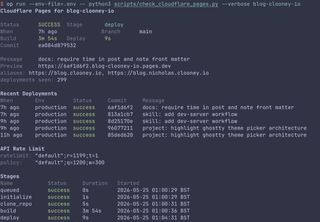
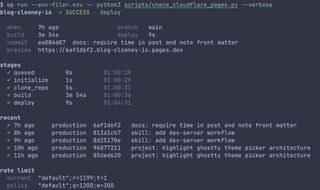
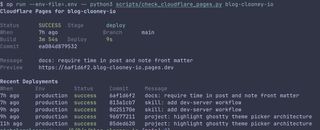
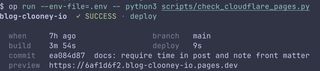
I've been iterating on scripts/check_cloudflare_pages.py, and this one ended up being a pretty clean example of where Claude currently feels stronger than Codex for TUI / UI design.

Codex got the script started and helped shape the core deployment-status workflow, but when it came to making the terminal output feel actually polished, especially across both the short and verbose views, Claude was noticeably better. At its best Codex still seems to struggle a bit with this kind of presentation work, so I ended up handing the UI pass over to Claude even though Codex had started the script.

View Codex Claude
Short version Short terminal output version of the Cloudflare Pages deployment status script produced with Codex Short terminal output version of the Cloudflare Pages deployment status script produced with Claude
Verbose version Verbose terminal output version of the Cloudflare Pages deployment status script produced with Codex Verbose terminal output version of the Cloudflare Pages deployment status script produced with Claude
Short and verbose output passes for the same Cloudflare Pages deployment-status script, comparing Codex against Claude.
Nicholas Clooney

feature: ghostty-theme-picker v0.2.0

I shipped v0.2.0 of ghostty-theme-picker, a two-column TUI theme browser for Ghostty that lets me compare dark and light themes side by side, star favorites, and keep jump history while I browse. The new release adds forward history and persistent browse state, but the engineering bit I especially like is leaning on a functional core and imperative shell, so most of the state transitions stay pure and surprisingly testable even though the app lives in the terminal. I also recorded a short demo below so I have a visual snapshot of how it feels in motion.

Nicholas Clooney

thoughts: The dotfiles card image is uncannily real

I keep staring at the new dotfiles project card image, generated by GPT, and getting a little mind-blown. Not only is every bit of text actually real text rather than the usual AI gibberish, the content itself coheres: the Ghostty window on the left shows plausible git aliases, the tmux pane in the middle has a believable folder listing, a git log, and a btop-style stats block, and the Emacs frame on the right has elisp in init.el and YAML in config.yml that kinda parse as real config.

And on top of that, Ghostty, tmux, and Emacs are exactly the tools I actually use, even if I haven't reached for those particular git aliases in a long, long time.

Generated overhead shot of a desk with three terminal windows showing Ghostty git aliases, tmux with folder listing and btop stats, and Emacs with elisp and YAML config
The dotfiles card image, with text that is somehow all real and coherent.

Still huh. Genuinely surprised by how far this has come.

Nicholas Clooney

feature: Ghostty and Emacs polish in dotfiles

I shipped v2026.05.2 of dotfiles as a follow-up polish pass on yesterday's tmux and Emacs reset.

This release adds a basic macOS Ghostty config, restores a bunch of the small Spacemacs habits I still wanted like fuzzy M-x, Helm buffer switching, avy motion, kj insert escape, project ripgrep search, restart and pasteboard bindings, plus YAML mode for config editing.

I also tightened the repo's own agent and release docs with AGENTS.md, CLAUDE.md, and a clearer note that these tags are chronological snapshots rather than semver, which makes the setup feel more intentional and easier to keep evolving.

Nicholas Clooney

note: Minimal OpenXR-OSX MVP for hello_xr on Quest

I published Minimal OpenXR-OSX MVP: hello_xr on Quest from macOS, then turned it into a real end-to-end proof instead of leaving it as a plan. The note now covers the successful native macOS -> OpenXR-OSX -> Quest run, includes a short clip of the headset result, and explains that the runtime's built-in streaming server brought the Quest out of its blue standby screen into the actual hello_xr cubes scene before a later retest negotiated a real 90Hz path too. The visible drops and patchiness are documented with the important caveat that my wireless network environment was not tuned for this test, so I do not want to over-attribute those artifacts to the runtime alone.

Nicholas Clooney

note: Can CrossOver OpenXR talk to OpenXR-OSX?

I published Can CrossOver OpenXR Talk to OpenXR-OSX?, a follow-up note to the earlier Quest and Virtual Desktop dead-end notes. The useful part is that Elite reaching a Windows OpenXR runtime boundary in CrossOver does prove the app side is alive, but the bad news is that handing that off to OpenXR-OSX would need a custom Windows runtime shim, IPC bridge, and host-side adapter rather than a simple runtime switch.

Nicholas Clooney

note: Quest PCVR and Virtual Desktop / CrossOver findings

I published Quest PCVR on Apple Silicon Mac via CrossOver and Virtual Desktop / CrossOver Findings, two notes that document the same dead end from slightly different angles. One explains why Quest PCVR from macOS through CrossOver fails at the runtime/compositor layer, and the other captures the bottle-level evidence from Virtual Desktop Streamer, SteamVR, and OpenXR probing. Together they are the version I wish I had before spending more time treating this like a tweakable game-config problem.

Nicholas Clooney

blog: My AI-Assisted Terminal Setup: Subspace Emacs and a Tmux Layout Shortcut

I published My AI-Assisted Terminal Setup: Subspace Emacs and a Tmux Layout Shortcut, the fuller write-up that ties together the tmux 70/20/10 layout and the move off Spacemacs into Subspace Emacs. It covers how Claude and Codex split the work between research and implementation, the tmux-as-TDD-harness approach that unblocked the layout binding, and the tmux/tmux#1839 discovery that finally let swap-pane preserve zoom state. This supersedes the two narrower notes from earlier today.

Nicholas Clooney

post: Building a Lightweight Emacs Config After Spacemacs

I published Building a Lightweight Emacs Config After Spacemacs, the fuller write-up I promised when I shipped the dotfiles update earlier today. It walks through why I left Spacemacs, what I kept (Evil, leader keys, Magit, Helm-style tracked file finding, early theme loading), and how the new ~/.emacs.d is organized as a small set of explicit modules instead of a framework.

Nicholas Clooney

feature: Lightweight Emacs migration and tmux workflow

I shipped v2026.5.1 of dotfiles, which pairs a nicer tmux workflow with the move away from the old Spacemacs setup into a smaller hand-rolled Emacs config. The tmux side gives me a one-keystroke 70/20/10 vertical layout plus a safe top-and-middle pane swap, while PR #2 keeps the core editor ergonomics I care about like Evil, leader keys, Magit, Helm-style tracked file finding, and early theme loading without the extra framework machinery. This is the point where the repo feels easier to understand and own, and I want to do a fuller write-up on the tmux and "Subspacemacs" workflow soon.

Nicholas Clooney

note: Tmux 70/20/10 Layout Shortcuts

Published Tmux 70/20/10 Layout Shortcuts, a note about building a one-keystroke tmux layout that creates a stable 70/20/10 vertical stack and only allows pane swapping when the window is explicitly tagged as that layout. The useful part was not just the final run-shell binding, but the testing approach: using detached tmux sessions plus list-keys, list-panes, and show-options as a lightweight TDD harness before touching the real config. This is one piece of a broader terminal and editor workflow cleanup, and I want to write that larger tmux plus lightweight Emacs story up properly soon.